The support service that became a sales channel: I built it from scratch and it still brings in referrals
When I joined Kaleb Brasil, there was no support service. My father, the company’s founder, looked after customers on his own, by phone and in person. I was the first employee and I built the support service from scratch.
Supportby phone only, without seeing the customer’s screen
what can you see on your screen?
CompanyNo process, no team and no remote access.
the receipt printer has stopped!
a stopped till is a lost sale
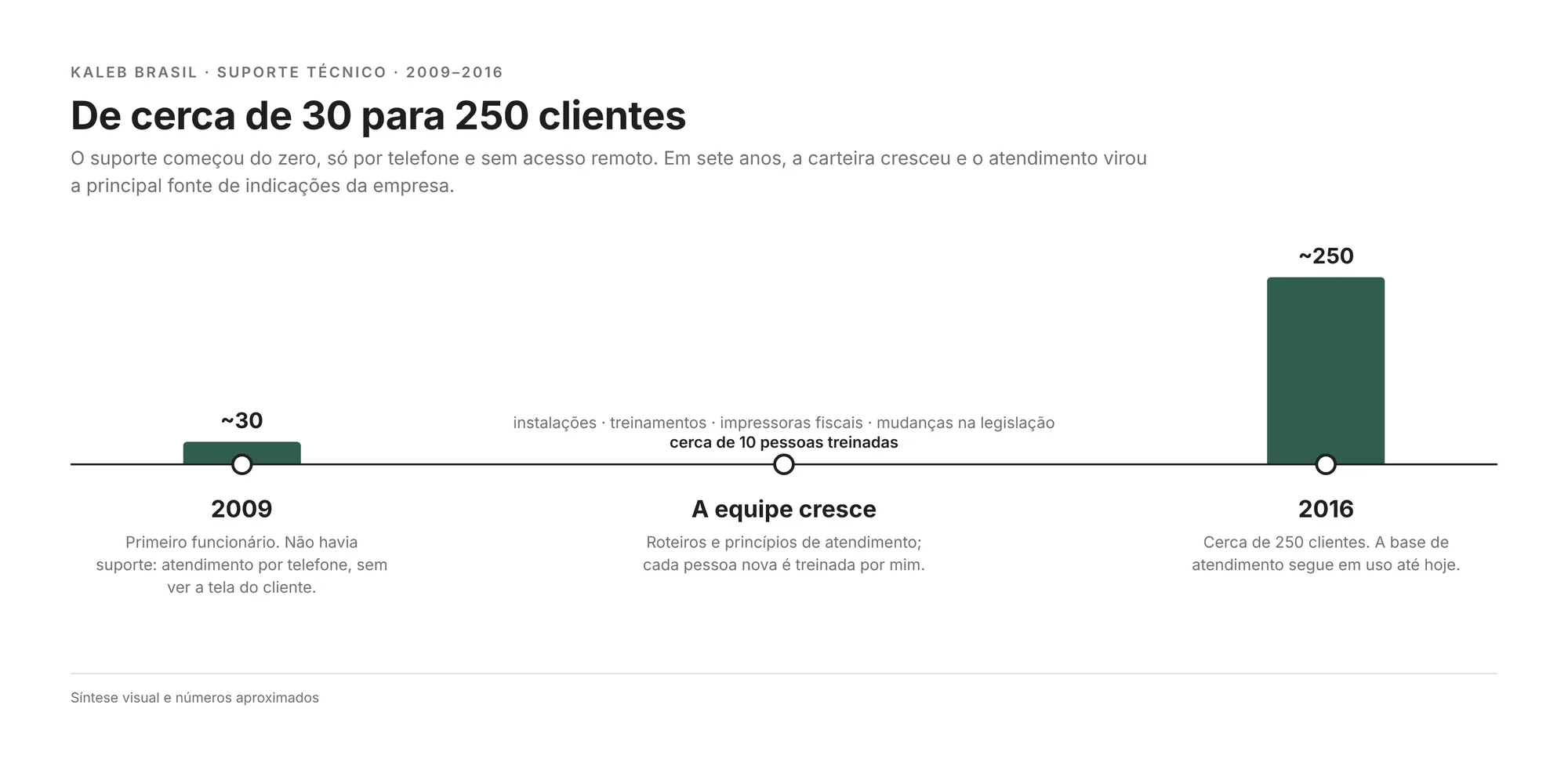
From around 30 to 250 customers.
And I carried out most of the installations and training in that period.
Around 10 people trained.
They worked in support using the service scripts and principles I created.
The foundation is still in use.
And customer feedback is the same as when I looked after them on my own.
Support became the company’s trump card.
It is the reason Kaleb gets so many referrals, still its main source of new customers.
- My role
- First employee: creating the support service, customer installations and training, service scripts, team training; later, technical support manager
- Period
- 2009 to 2016
- Customers
- Small and medium-sized retailers: grocers, shops, restaurants and others
- Technology
- Retail automation systems, old and new fiscal printers, label printers and updates for changes in tax rules
Solving problems without seeing them
There was no process, no team and no remote access. Every request was handled by phone or by going to the customer.
Without seeing the screen, I had to understand from the customer’s voice what was happening on their computer or fiscal printer and explain, step by step, how to fix it. Every call was an exercise in listening: asking the right questions, translating what the person described and speaking their language, not the technician’s.
That is where I learned to listen
To solve a problem without seeing it, I needed to understand:
- Who was on the other end and how much they knew about technology.
- What they were actually seeing, not what I imagined.
- What they needed to keep working, because for a shopkeeper a stopped till is a lost sale.
This way of serving people became the basis of everything I do in design today: understanding the real context of the people who use something before proposing any solution.